Less smoke – more nicotine?
Fewer people smoke – but nicotine has not disappeared from everyday life; it has simply taken on new forms. E-cigarettes and nicotine pouches are more discreet, but they can also make consumption and health consequences easier to hide.
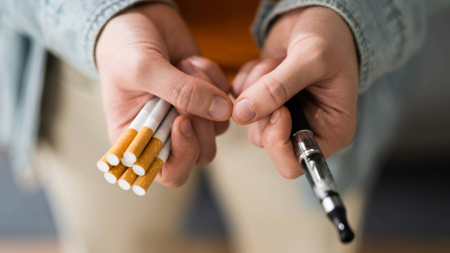
You can see it every day: there are fewer people smoking. The number of people who smoke has decreased significantly, and traditional ashtrays are gradually disappearing from the urban landscape. This is not a coincidence: In Switzerland, the number of smokers has fallen over the past few decades (e.g. 33% in 1997 compared to 24% in 2022). But, at the same time, nicotine has not gone away. It has just changed its form.
Today, people are vaping and consuming snus, which is quieter, more discreet, less noticeable and more or less odourless. And it is precisely because of this that it is more difficult to understand what is actually going on.
Visible and more aware
Cigarettes are obvious: you light one up, smoke it, and at some point, it is finished. Doing this makes it easier to see and be more aware of how much you are smoking.
This limit is often missing when it comes to vapes (e-cigarettes). Many people use them in short bursts throughout the day, with no clear beginning or end. Statistics on this are also available for Switzerland: in 2022, 3% of the population smoked e-cigarettes at least once a month. Among 15 to 24-year-olds, this figure was 5.7%. It may seem less harmful, but this is not necessarily the case.
Vaping does not just produce harmless water vapour. It is an aerosol made up of very fine particles, which is inhaled. And: the amount of nicotine that is actually absorbed by the body depends on factors such as the device, the liquid and how it is inhaled. Consumption can accumulate precisely because it often feels trivial, happening quietly and without a conscious decision.
Snus and nicotine pouches: inconspicuous, but not without an impact
In the first instance, snus and nicotine pouches may seem even less harmful: they produce no smoke, no vapour and none of the typical odour. Approximately two per cent of the population in Switzerland use snus (oral tobacco), with a higher proportion among younger people.
What you tend to see are the effects it has on the mouth: where a pouch is regularly located, the gums may recede, causing irritation to the tissue and changes to the oral mucosa. The tricky thing about this is: there is no discomfort at the beginning. And that is precisely why it is often ignored – until the damage becomes apparent.
The same thing applies in this case, too: just because it is less visible does not mean there is less of an impact. Nicotine will always be addictive, no matter if you smoke it, vape it, or place it in your mouth.
So are vapes better or worse than cigarettes?
The honest answer is: it depends.
Vapes can be a short-term solution for adult smokers who want to give up cigarettes. Since they do not involve combustion, they generally produce fewer by-products than smoking. However, the important thing is whether smokers can stop smoking completely. In addition, there is evidence to support that they help people to give up smoking: e-cigarettes containing nicotine can increase the likelihood of quitting compared to traditional nicotine replacement therapies.
It becomes an issue when vapes are used not as a way to quit, but as an addition to an existing habit or as a gateway – especially among young people. Taste and lifestyle appeal are discussed in specialist literature as key factors and risks. Many vapes have sweet or fruity flavours, so it is no longer the case of inhaling unpleasant-smelling smoke into your lungs.
What this means for the health care system
The decline in smoking is welcome news – both from a medical and financial point of view in the long term. At the same time, challenges are shifting:
- Prevention needs to start earlier
- Conversations are becoming more nuanced
- The issue is not so much about smoking: yes or no
- And more about the consumption of nicotine overall.
The decisive question nowadays is no longer just: “Do you smoke?”
but: “What is your nicotine use like?”
Not by pointing the finger, but with clarity
No one benefits if new nicotine products are vilified or trivialised. What helps is to take a sober view:
smoking less is an achievement.
Nicotine is still around – but in new forms.
Adults need help to quit, not a sense of guilt.
Young people need to be protected before they develop habits that are difficult to break later on.
Health does not begin by banning things. It begins when people start to notice what they are doing – and why.
Cigarettes, vapes or nicotine pouches: it is worth taking a moment to reflect and honestly consider the role nicotine plays in your day-to-day life. Not out of fear. Not for moral reasons. Rather from a place of self-determination.
Please note: This article is for general information purposes only and is not intended as a substitute for medical advice. If you have any concerns about your health or would like support in giving up smoking or nicotine, please consult your doctor or a specialist centre.