When leg pain may be a sign of a herniated disc
A slipped or herniated disc is a fairly common condition that affects the spine. PD Dr. med. Sven Hoppe treats many patients diagnosed with this condition at the Centre for Spinal Medicine at Hirslanden Salem Hospital. Most patients respond well to a conservative treatment approach.
Spinal specialist PD Dr. med. Sven Hoppe is in a consultation with a patient.
Loris Nowak is 38 years old and works as a graphic designer at an advertising agency. Due to his line of work, he spends a lot of time sitting in front of a screen. Like many people whose work involves sitting at a desk, he suffers from constant back pain. In November, he suddenly started having intense pain in his left leg. Without painkillers, he can no longer work sitting down. In January, he could no longer stand on the tips of his toes. He consulted his general practitioner, who immediately referred him to the specialist PD Dr. med. Sven Hoppe because he suspected a herniated disc.
Impaired sensation in the leg
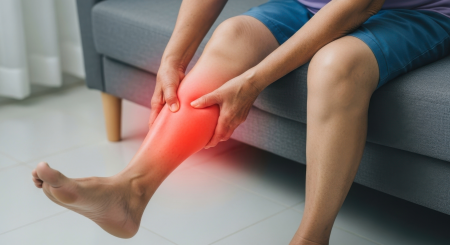
Sven Hoppe is a spinal specialist at his own practice, Wirbelsäulenmedizin Bern AG, and at the Centre for Spinal Medicine at Salem Hospital, where he is an accredited partner physician. He often treats patients like Loris Nowak. Initially, the doctor will want to locate the main source of the pain. “Back pain is not always directly related to a herniated disc. The telltale signs are pain, numbness and loss of strength in one or both legs”, says Sven Hoppe. It turned out that Loris Nowak had been suffering from pain in his leg for around three weeks and that the weakness on his left side was getting worse. The spinal specialist referred him for an MRI scan.
Severity of the prolapse
This is the standard procedure for patients experiencing back pain that radiates to other parts of the body. The herniated disc needs to be located and its severity determined. This is extremely important for deciding on a course of treatment. Sven Hoppe makes it clear: “surgery is not usually the treatment we would go for first. This would be infiltration (cortisone injection) combined with physiotherapy and non-steroidal anti-inflammatory pain medication.” This non-surgical treatment approach works for 80% of those affected. “Infiltration can be performed very quickly and usually has a very positive outcome,” adds the doctor.
Surgery nonetheless
The patient undergoes a reassessment after four weeks of conservative treatment. The patient’s neurological symptoms, i.e. impaired sensation and loss of strength, have not improved. The herniated disc needs to be surgically removed. Loris Nowak is expected to stay in hospital for two days following the minimally invasive surgery. His entire recovery period takes around six weeks. After that, he can slowly begin to build up his physical fitness once again. As a general rule, Sven Hoppe says: “For almost all patients with back problems, I recommend getting plenty of exercise and doing sports that strengthen the back, such as yoga, Pilates or swimming – ideally as a preventive measure, but also as part of follow-up care.”
Quote: “Surgery is not usually the treatment we would go for first” – PD Dr. med. Sven Hoppe, spinal specialist and partner physician at Hirslanden Bern